
Your most expensive renovation isn't the Italian marble in the lobby or the custom linens in the guest suites. It's the amateur gallery sitting on your website right now. The true cost of bad hotel photography is a compounding visual debt that erodes your brand equity every time a potential guest clicks away. While you've invested heavily in property upgrades, mediocre imagery acts as a ceiling on your potential. It forces a race to the bottom on pricing and keeps your Average Daily Rate stagnant.
You know your property deserves a premium, yet you're likely watching guests migrate to OTAs because your direct website doesn't inspire confidence. It's a frustrating gap between the physical experience and the digital invitation. This guide reveals how subpar visuals kill conversions and why properties using professionally staged 4K photography see booking lifts as high as 22%. We'll show you how to justify a strategic creative budget and command a premium price point in the crowded Miami market. Get ready to replace stagnant imagery with a visual narrative that drives direct growth and eliminates OTA dependency.
Key Takeaways
- Identify your visual debt. Understand how low-quality imagery acts as a high-interest loan that erodes your brand equity and future revenue.
- Command a premium price point. Quantify the ADR gap and learn how professional visual storytelling justifies a 10-15% increase in room rates.
- Bridge the trust gap. Eliminate the cost of bad hotel photography by creating a cohesive aesthetic across Instagram, TikTok, and your official website.
- Sell the Miami lifestyle. Move beyond sterile architectural shots to embrace "Ambient Realism" that captures the vibrant experience modern guests crave.
- Modernize your creative strategy. Discover why the single-shoot model is obsolete and how content retainers ensure your property remains a market leader in 2026.
Visual Debt: Why Subpar Imagery is Your Hotel’s Most Expensive Liability
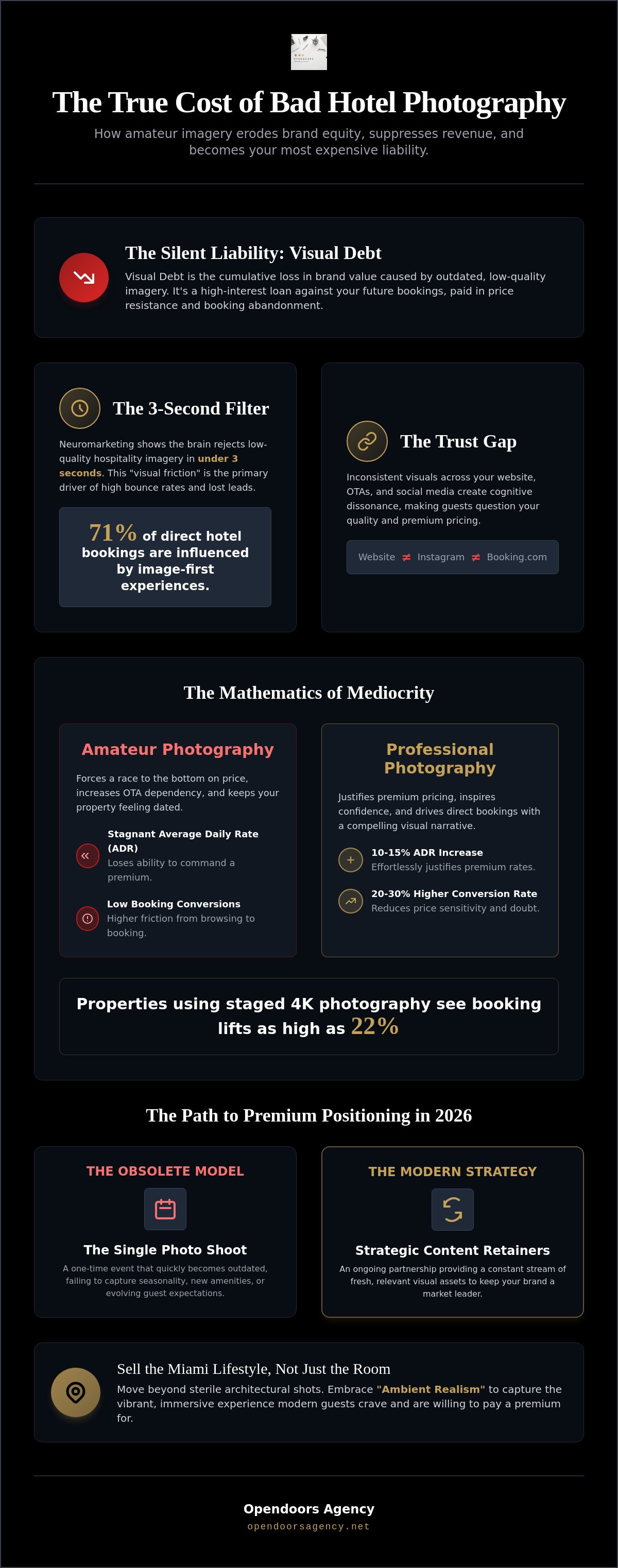
Visual debt is the silent liability sitting on your balance sheet. It represents the cumulative loss in brand equity and revenue caused by outdated, uninspired, or low-quality assets. While traditional debt is visible, visual debt is insidious. It erodes your property's value behind the scenes. Every time a potential guest views a grainy room shot or a poorly lit lobby, you're paying interest. This interest comes in the form of price resistance and booking abandonment. You've likely spent millions on the physical property, but the digital representation is currently working against you.
Think of mediocre imagery as a high-interest loan against your future bookings. You might save on upfront costs by delaying a professional shoot, but the long-term cost of bad hotel photography is staggering. In the 2026 hospitality landscape, visuals are no longer just a marketing asset; they're the primary filter for luxury selection. If your digital presence feels dated, your property feels dated. There's no middle ground. "Good enough" is the fastest way to kill a premium brand. It signals a lack of attention to detail that guests assume extends to your service standards.
The Compounding Effect of Brand Erosion
A million-dollar renovation is effectively invisible if your OTA listings feature flat, amateur photography. This creates a dangerous disconnect between the physical experience and the digital invitation. When guests see mismatched quality, they experience cognitive dissonance. They begin to question the validity of your premium pricing. This erosion isn't limited to guests. Visual debt impacts staff morale and your local reputation. It's difficult for a team to maintain a luxury standard when the brand’s public face feels cheap or neglected. High-quality imagery anchors your positioning and justifies your ADR to the market.
The 3-Second Filter: Why First Impressions Are Final
Neuromarketing research indicates the human brain rejects low-quality hospitality imagery in less than three seconds. This is the "3-Second Filter." If a hero image feels amateur, the brain triggers a subconscious doubt known as visual friction. This friction is the primary driver of high bounce rates. Modern digital marketing strategies rely on seamless visual storytelling to convert traffic into direct revenue. Since 71% of direct hotel reservations are now influenced by image-first experiences, your website's performance is directly tied to the caliber of your content. If you aren't leading with vibrant, expert visuals, you're essentially inviting guests to book with the competition.
The Mathematics of Mediocrity: Quantifying Lost Revenue and ADR Erosion
Mediocre imagery is a persistent leak in your revenue bucket. It isn't just an aesthetic oversight; it's a mathematical failure that directly suppresses your bottom line. When your digital assets fail to inspire, you lose the ability to command a premium. The hidden cost of bad hotel photography manifests most clearly in your Average Daily Rate (ADR). Properties with professional, high-end imagery consistently capture a 10% to 15% price premium over competitors with amateur visuals. This isn't a coincidence. It's the result of reduced price sensitivity. High-quality visuals move the guest's focus from "how much does this cost" to "how soon can I be there."
Conversion rate optimization lives or dies by visual storytelling. Data from the 2026 hospitality market shows that properties with professional photography see booking conversion rates 20% to 30% higher than those relying on amateur imagery. This gap represents thousands of dollars in lost potential every month. When your visuals are sharp, vibrant, and strategically composed, they reduce the friction between browsing and booking. You aren't just selling a room; you're selling a guaranteed emotional outcome. If the imagery is flat, the perceived value of that outcome drops, and your revenue follows.
ADR and the Premium Pricing Power
Consider two boutique hotels in Miami Beach with identical square footage and amenities. One invests in a comprehensive visual narrative, while the other relies on "good enough" shots from a local freelancer. The first hotel justifies its resort fees and luxury surcharges effortlessly. Guests accept the higher price because the visuals promise an elite experience. Research from the Journal of Travel Research confirms that specific visual elements dictate viewer attention and directly influence choice. Professional photography allows you to anchor your brand at a higher price point, effectively making your ADR a choice rather than a reaction to market pressure.
Direct Booking vs. OTA Commissions
Modern guests use OTAs to browse but visit your official site to verify the "vibe." This is where the conversion either happens or dies. If your direct site features lower-quality photos than Expedia, the guest returns to the OTA to book. You then pay a 15% to 25% commission on a guest you already had. Effective hotel website design Miami relies on elite photography to close the deal and bypass these commissions. By elevating your property's visual narrative, you reclaim your margins and build a loyal, direct-booking audience. Every amateur photo on your site is essentially a referral link for a third-party platform.
The financial damage extends into post-stay operations. "Not as Pictured" complaints are a significant driver of refunds and negative reviews in 2026. When your marketing imagery is inconsistent or poorly executed, you create a trust gap. Guests arrive with expectations that the physical reality can't meet, leading to costly service recoveries. Investing in accurate, high-fidelity visual assets isn't just about getting guests in the door; it's about protecting your reputation and ensuring every stay is a profitable one.
The Trust Gap: How Inconsistent Visuals Lead to Booking Abandonment
Trust is the ultimate luxury. In a market saturated with options, guests look for reasons to say no. Inconsistent visuals provide exactly that. The cost of bad hotel photography is most evident when your digital assets don't match the physical reality. The "Catfishing" effect, where a property looks significantly different online than it does in person, creates a profound sense of betrayal before the guest even checks in. This mismatched expectation is a primary driver of booking abandonment. When your marketing imagery feels disjointed, you're signaling a lack of operational integrity. If you can't manage your photos, guests assume you can't manage their stay.
Many hoteliers lean on the excuse that their "rooms look better in person." This is a fundamental marketing failure. If the physical reality outshines the digital presentation, you're leaving money on the table. You're failing to capture the very essence that makes your property special. Using high-end visual storytelling for hospitality is about more than just showing a bed; it's about building authentic trust through transparency. It ensures that the promise made online is the reality delivered at the front desk.
The Psychology of Luxury Purchase Decisions
Luxury guests aren't just booking a room. They're booking a version of themselves. Every image must reinforce that aspirational identity. Professional lighting and strategic composition do more than look pretty; they signal safety, cleanliness, and order subconsciously. A crisp, well-exposed shot of a bathroom suggests a level of hygiene that a grainy, dark photo never could. This is the "Halo Effect" in action. One iconic architectural shot can elevate the perceived value of every other room in the property, reducing the friction that leads to abandonment.
Social Proof and the Instagram Disconnect
The cost of bad hotel photography becomes painfully visible when a guest's tagged photos on Instagram look more professional than your official gallery. This disconnect destroys brand authority. High-net-worth travelers and tastemakers value consistency above all else. If your website is polished but your Instagram feed feels cheap or neglected, the trust gap widens. They want to see that your property is "Instagrammable" from every angle, not just the ones you've carefully staged.
This visual harmony must extend to every touchpoint. Aligning your social media for upscale restaurants and bars with your main hotel imagery ensures a seamless guest journey. When your digital presence feels like a unified narrative, you eliminate the friction that causes abandonment. You replace doubt with desire. By investing in a consistent visual language, you position your property as a reliable choice for the discerning traveler.
The Lifestyle Deficit: Why Architecture Alone Won’t Sell Your Miami Experience
In 2026, the hospitality market has moved beyond the commodity of a "room." Premium travelers aren't looking for square footage; they're looking for a transformation. If your gallery consists solely of wide-angle architectural shots, you're suffering from a lifestyle deficit. The cost of bad hotel photography in this context is the loss of the "vibe" that defines Miami luxury. Wide lenses often distort space and feel clinical. They fail to capture the sensory details that actually drive a booking decision. You're selling an atmosphere, not just a floor plan.
Successful imagery focuses on vignettes. It captures the condensation on a poolside cocktail, the specific grain of custom woodwork, and the golden "Miami Glow" that filters through a terrace at sunrise. These details tell a story. They invite the guest to imagine themselves in the space. Without these narrative anchors, your property remains a generic building rather than a destination. High-end guests expect to see the vibrancy and elite positioning of your brand reflected in every frame.
Capturing the Narrative, Not Just the Square Footage
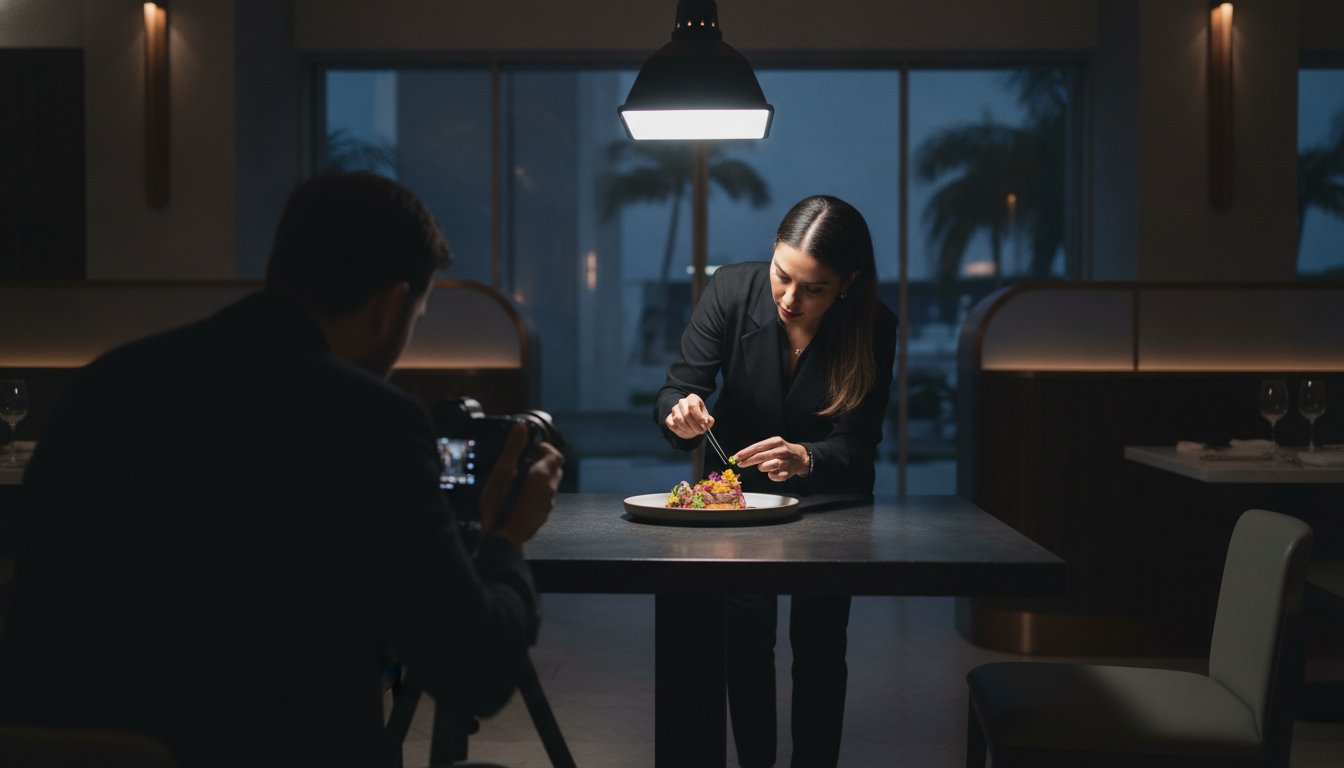
Architecture is static. Narrative is fluid. Use implied presence to create an emotional connection. A draped silk robe, a half-read book on a nightstand, or a perfectly placed espresso can bridge the gap between a room and a home. Food and beverage imagery is often the first touchpoint for a guest exploring your property. If your bar looks uninspired online, the guest assumes the entire experience is lackluster. Integrating high-end restaurant photography Miami into your hotel’s visual ecosystem is essential. It creates a comprehensive luxury narrative that sells the entire property, not just the bed.
The Short-Form Video Tax
There's a hidden tax on properties that ignore motion. In 2026, stagnant imagery signals a stagnant brand. If you don't have video-ready assets for TikTok and Reels, you're missing the "TikTok-to-Booking" pipeline that now influences a majority of direct reservations. Bad photography usually suggests a lack of high-end video content. Stills and motion must speak the same luxury language to maintain brand authority. If your visual assets feel disconnected, you lose the "tastemaker" demographic that drives social proof. Modernize your visual assets to capture the full Miami experience and eliminate this lifestyle deficit.
Investing in Visual Excellence: The Path to Premium Positioning in 2026
Auditing your current assets is the first decisive step toward reclaiming your brand's market value. You must identify where the "visual leaks" are occurring within your digital presence. These leaks are the points where your imagery fails to match the physical excellence of your property. In the hyper-competitive South Florida market, the cost of bad hotel photography is a permanent stain on your reputation that drives guests toward more visually cohesive competitors. Visual excellence fuels your entire hospitality marketing Miami strategy. It provides the essential foundation for your website, social channels, and overall brand authority.
A single annual shoot is no longer sufficient to maintain a premium position in 2026. The speed of digital consumption requires a more dynamic approach. This is why the "Content Retainer" model has become the standard for elite properties. It ensures a steady stream of fresh, high-end assets that reflect seasonal shifts and emerging guest expectations. Choosing a Miami creative agency for hospitality beats hiring a generalist photographer every time. You need a partner who understands the specific "Miami Glow," the local cultural nuances, and the aesthetic demands of the world's most discerning travelers. Generalists capture rooms; specialists capture the soul of a destination.
Developing a Visual Identity System
Moving beyond a simple logo is essential for true luxury positioning. You need a comprehensive visual language that defines your brand's soul across every touchpoint. We develop a "Brand Bible" for all future content production to ensure absolute consistency. Every shot must serve a specific business outcome. Whether you're aiming to increase your ADR, drive F&B revenue, or book high-end events, your visuals must be strategically aligned with those goals. This systematic approach eliminates creative guesswork and ensures your budget produces a tangible ROI. It transforms photography from a line-item expense into a powerful revenue driver.
The Opendoors Advantage: Effortless Luxury
We offer a sophisticated, hands-off approach to high-end content production. Our Miami-based team understands how to capture the specific vibrancy and elite positioning of South Florida hospitality. We handle the logistical complexity so you can focus on delivering an exceptional guest experience. The transition from visual debt to visual excellence should be seamless and well-managed. Your next step is clear. You must audit your property's current status and identify the gaps in your narrative. We guide you through this process, replacing stagnant imagery with a vibrant visual identity that commands market leadership and eliminates the cost of bad hotel photography for good.
Reclaiming Your Property's Market Leadership
Visual debt is a choice. You can continue to let mediocre imagery erode your brand equity, or you can pivot toward a strategy that justifies your premium. We've explored how the cost of bad hotel photography manifests in stagnant ADR, high OTA commissions, and a persistent trust gap. In the 2026 Miami market, your digital narrative is your most powerful tool for growth. It's the difference between being a commodity and becoming a destination. By prioritizing visual storytelling, you eliminate the lifestyle deficit and speak the language of elite guests.
Transforming your image requires more than a camera; it requires a partner who understands the intersection of creative artistry and business strategy. Opendoors Agency specializes in Miami hospitality aesthetics. We offer comprehensive Branding and Photography services designed with a strategic focus on ADR and direct booking growth. We take the operational burden off your shoulders, delivering a polished, modern identity that resonates. It's time to stop paying interest on visual debt and start investing in excellence. Elevate your property's visual narrative with Opendoors Agency and secure your place at the top of the market. Your property’s next chapter starts with a single, decisive frame.
Frequently Asked Questions
How often should a luxury hotel update its photography?
Luxury hotels should refresh their primary visual assets every 12 to 18 months. This timeline ensures your imagery reflects current design trends and guest expectations for 2026. If you've completed a soft goods refresh or updated your F&B program, a shoot should happen immediately. Keeping your gallery fresh prevents the compounding cost of bad hotel photography that occurs when guests spot discrepancies between your digital presence and the physical property.
Can I use AI to enhance my existing hotel photos?
AI is an excellent tool for precision retouching and technical correction, but it can't fix a fundamentally flawed composition. Using AI to "save" amateur shots often results in an uncanny, artificial look that destroys guest trust. Real luxury relies on authentic lighting and expert staging. Use technology to enhance professional captures rather than attempting to mask the underlying issues of low-quality source material.
What is the difference between architectural photography and lifestyle photography?
Architectural photography highlights the structure, design, and physical layout of your property. It’s technical and precise. Lifestyle photography captures the emotional experience, focusing on vignettes, human elements, and the "vibe" of a stay. Successful hospitality brands use a blend of both to sell the physical space and the aspirational lifestyle. One shows where they sleep; the other shows how they'll feel.
How does photography affect my hotel's SEO ranking?
Search engines prioritize user experience, and high-quality imagery is a primary driver of engagement. When guests stay on your site to view vibrant galleries, it signals to Google that your content is valuable. This reduces bounce rates and increases dwell time, both of which are critical SEO ranking factors. Professional photography ensures your site remains a high-performing destination that captures organic traffic effectively.
Is it better to hire a local Miami photographer or a national agency?
A local Miami partner offers an intuitive understanding of the specific light and "vibe" that defines South Florida luxury. While national agencies have reach, they often lack the "tastemaker" insight required to capture the authentic Miami experience. Choosing a local creative partner ensures your property benefits from specialized expertise while maintaining a hands-on, service-oriented relationship that understands the hyper-competitive local market.
How much should a hotel budget for professional photography in 2026?
Your photography budget should be viewed as a percentage of your projected ADR growth rather than a one-time expense. Industry research indicates that properties investing in high-fidelity visual assets see significant improvements in booking velocity. Allocate a budget that allows for comprehensive coverage, including stills, motion, and F&B details. This strategic investment eliminates the cost of bad hotel photography by ensuring every asset drives a tangible business outcome.
Do I really need professional photos for my hotel's social media?
Social media is often the first touchpoint for the modern traveler. If your Instagram feed relies on amateur smartphone shots while your website looks professional, you create a disjointed brand image. Professional social content ensures consistency across the entire digital journey. High-quality assets for TikTok and Reels are now essential for capturing the "influencer" demographic and maintaining a prestige positioning in the 2026 market.
What are the essential shots every boutique hotel needs for its website?
Every boutique hotel needs a diverse "shot list" to convert modern guests. Essential assets include a commanding hero shot of the lobby, intimate suite vignettes that highlight textures, and vibrant F&B details. Don't overlook lifestyle captures of your pool or terrace during "golden hour." These specific images provide the visual proof guests need to justify a premium booking and feel confident in their choice.