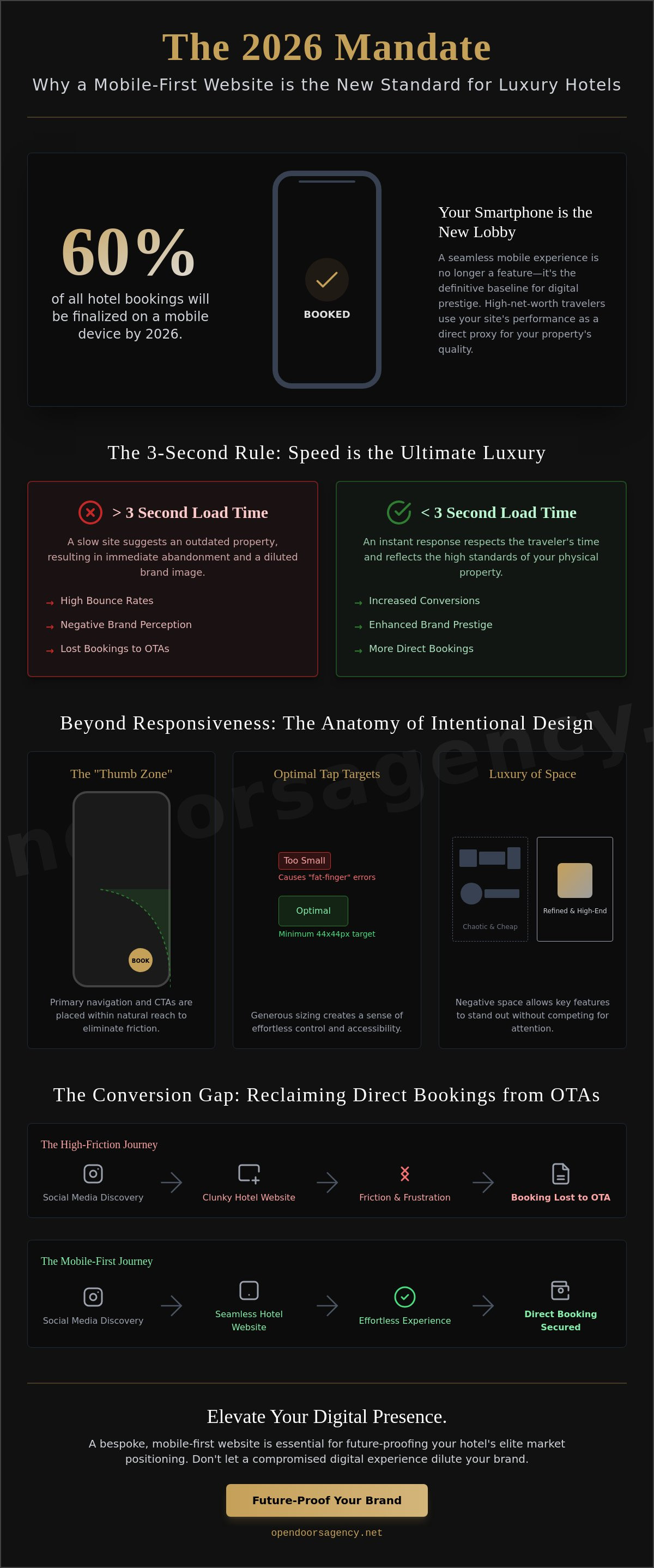
By 2026, 60% of all hotel bookings are finalized on a mobile device. This shift makes your smartphone interface the primary lobby of your property. If this digital entry feels cramped or slow, high-net-worth travelers will assume the physical stay follows suit. The importance of a mobile-first hotel website has moved beyond technical convenience; it is now the definitive baseline for digital prestige and brand authority.
You've likely watched premium guests migrate toward OTAs because your mobile experience feels clunky compared to their streamlined apps. It's a frustrating reality where a luxury brand's image is diluted by poor UX and high bounce rates. This guide demonstrates how a mobile-dominant strategy recaptures those direct bookings and ensures your online presence feels as refined as your physical suites. We'll examine the specific design standards, interaction targets, and speed requirements needed to future-proof your brand for 2026 and beyond. Prepare to transform your digital presence into a high-conversion asset that reflects your true hospitality standards.
Key Takeaways
- Understand why modern guests use mobile site performance as a direct proxy for the quality of your physical property.
- Master the "Thumb Zone" and mobile-first architecture to eliminate friction in the guest's digital journey.
- Discover the importance of a mobile-first hotel website for reclaiming direct booking shares from high-commission OTAs.
- Learn how to adapt high-end photography and micro-copy to maintain brand prestige on smaller screens.
- Explore why bespoke digital builds are essential for future-proofing your hotel's elite market positioning through 2026.
The Digital Lobby: Why Mobile-First is the New Standard for Luxury
Your website is no longer a digital brochure; it's the primary interface of your brand. Mobile-first design isn't a technical checkbox or a secondary consideration. It's a philosophy that treats the smartphone as the lead platform, not a shrunken version of a desktop site. For the luxury sector, this shift is absolute. Your digital entry point must reflect the same intentionality as your physical lobby. If the digital experience feels neglected, the guest assumes the property is too.
The "Digital First Impression" theory dictates that guests judge the quality of your service by the speed of your mobile pages. A site that lags suggests a property that's outdated. In 2026, speed is the ultimate luxury. Research indicates that more than half of mobile users abandon a site if it takes longer than three seconds to load. Recognizing the importance of a mobile-first hotel website is about respecting the traveler's time and expectations. Your mobile site is your most visible concierge, always available and instantly responsive.
Statistics from 2026 show that over 75% of luxury travel research now begins and ends on a smartphone. This isn't just casual browsing. It represents the full cycle of discovery, comparison, and conversion. By prioritizing the mobile build, you ensure that your brand's prestige remains intact across the most used channel in the industry.
The 2026 Traveler Profile
High-net-worth Gen Z and Millennial travelers now dominate the luxury market. These individuals prioritize instant visual gratification and seamless utility. Their standards for aesthetic excellence are non-negotiable, and their attention spans are optimized for speed. They bypass desktops entirely during the discovery phase, relying on mobile platforms to curate their next stay. To capture this demographic, your digital presence must offer immediate, high-vibrancy storytelling that fits in the palm of their hand.
From Search to Stay: The Mobile Guest Journey
The modern guest journey often starts with a visual spark on social media. A traveler sees a vibrant shot of your penthouse suite and clicks the link in your bio. If that click leads to a clunky page that requires pinching and zooming, the "frictionless aspiration" of your brand is broken. They won't struggle with your site; they'll retreat to the familiar, streamlined interface of an OTA.
This is where the importance of a mobile-first hotel website becomes a financial imperative. Every point of friction acts as a tax on your marketing budget. By moving beyond basic Responsive Web Design and embracing a mobile-dominant architecture, you create a digital environment where the transition from discovery to direct booking is effortless. You aren't just building a site. You're designing a high-conversion pathway that honors your guest's preference for mobile-first living.
Beyond Responsiveness: The Anatomy of a High-End Mobile-First Design
Basic responsiveness is no longer enough to command the attention of the elite traveler. While adaptive layouts merely react to screen sizes, true mobile-first architecture is built from the ground up to prioritize the smartphone experience. This distinction is vital. A luxury site must feel intentional, not compromised. When you prioritize the importance of a mobile-first hotel website, you move beyond technical fixes and into the realm of strategic brand elevation. This approach ensures your digital presence matches the sophistication of hotel website design miami benchmarks, where visual impact and utility coexist perfectly.
Ergonomics drive the mobile-first philosophy. We focus heavily on the "Thumb Zone," ensuring that primary navigation and booking buttons sit within natural reach of the user's thumb. Research indicates that interactive elements should maintain a minimum size of 44x44 pixels, with 48x48 pixels being the optimal standard for primary actions. This precision eliminates the frustration of "fat-finger" errors, creating a sense of effortless control. To maintain a high-end feel, we leverage negative space. Crowded screens feel chaotic and cheap. Luxury requires breathing room, allowing your property's key features to stand out without competing for attention.
Speed as a Luxury Amenity
In 2026, a slow website is a broken promise. High-end users expect a total load time of under three seconds; anything slower results in immediate abandonment. We achieve this through advanced technical optimization, including intelligent image compression that maintains "retina" quality while stripping away unnecessary data. A Performance Budget is a pre-defined limit on the size and load time of web assets that ensures speed remains a non-negotiable priority throughout the design process. This rigorous focus on performance protects your brand from the 7% conversion drop associated with even a one-second delay.
Visual Storytelling on a Vertical Canvas
The transition to mobile requires a shift in how we present luxury assets. Wide-angle landscape shots often lose their impact on a 6-inch screen. Instead, we utilize vertical video and portrait-oriented photography to fill the vertical canvas completely. This creates an immersive experience that feels native to the device. We focus on intimate, detail-oriented shots—the texture of a linen sheet, the condensation on a poolside cocktail, or the glow of a sunset from a private balcony. This style of visual storytelling for hospitality builds an emotional connection that desktop browsing cannot replicate. By adopting a mobile-first mission, hotels can effectively compete with large-scale platforms by offering a superior, high-touch user experience. If you are ready to refine your digital image, consider how our web design services can transform your mobile presence into a high-performance booking engine.
The Conversion Gap: How Mobile UX Reclaims Direct Bookings
The belief that high-value travelers only finalize bookings on a desktop is a relic of the past. By June 2026, 60% of all hotel bookings occur on mobile devices, with revenue officially overtaking desktop for the first time. This shift highlights the critical importance of a mobile-first hotel website for any property serious about its bottom line. If your mobile experience is an afterthought, you aren't just losing guests; you're actively subsidizing your competitors through high commission fees.
Poor mobile UX acts as a heavy tax on your marketing budget. You pay for the traffic through social media and search, but a clunky interface ensures that traffic never converts. We bridge this gap by integrating sophisticated ux design for hotel booking websites that prioritizes speed and clarity. Opendoors Agency eliminates booking friction through custom UI that feels as intuitive as a guest's favorite luxury app. We transform your mobile site from a research tool into a high-performance revenue engine.
Competing with OTAs on the Small Screen
OTAs like Booking.com often convert at rates of 4-6% because they have mastered mobile simplicity. To beat them, your mobile site must offer more than just a room. Use mobile-only banners to highlight direct booking perks like complimentary breakfast or late check-out. Build immediate trust by placing mobile-optimized reviews and social proof within the natural scroll path. When a guest sees that 18% of travelers who start on an OTA eventually book direct, they need a reason to stay on your site. A seamless UI provides that reason, reinforcing the importance of a mobile-first hotel website in every interaction.
Frictionless Booking and Mobile Wallets
The booking process must be invisible. In 2026, Apple Pay and Google Pay are the standard for high-end hospitality transactions. Digital wallets have removed the hesitation once associated with small-screen payments, allowing guests to book a suite while on the move. We advocate for a "One-Tap" booking philosophy that minimizes form fields and manual data entry. Every extra tap on a mobile device reduces conversion by 10%. By streamlining the path to purchase, we ensure your digital lobby converts with the same efficiency as a seasoned reservationist. This methodical approach to visual excellence and strategic implementation ensures your brand captures the direct revenue it deserves.
Strategic Content: Optimizing Luxury Assets for Mobile Consumption
Content defines the soul of your digital presence. While we've established the architecture of the site, the actual assets you display determine the emotional response of your guests. Desktop photography often fails on mobile because it lacks the intimacy required for a 6-inch screen. A wide-angle shot of a grand lobby looks like a cluttered thumbnail on a smartphone. Recognizing the importance of a mobile-first hotel website means curating assets specifically for the vertical scroll. You need "Micro-Copy"—bold, punchy headlines that fit on a single line and deliver an immediate value proposition. This ensures your message remains clear even on the smallest screens.
Information hierarchy is your most powerful conversion tool. A mobile user decides to stay or leave within the first two seconds of landing on your page. They must see your brand identity, a high-vibrancy visual, and a clear path to booking without scrolling. We use specialized restaurant photography miami techniques to sell your on-site dining through detail-oriented close-ups that evoke sensory desire. This approach ensures your ancillary revenue streams are as visible as your room inventory. Every image should serve a strategic purpose, guiding the eye toward the next action.
High-Resolution Impact vs. Data Efficiency
Balancing high-resolution impact with data efficiency is a technical art form. We use "Miami vibrant" colors that pop on OLED screens while optimizing for battery life and load speed. The rise of WebP and AVIF formats allows for ultra-sharp hospitality imagery at a fraction of the file size of traditional JPEGs. When presenting architectural interiors, we focus on vertical crops that emphasize height and grandeur. This maintains a sense of scale that landscape shots lose when shrunk down for mobile consumption. It's about delivering elite visual quality without sacrificing the performance your guests expect.
Brand Voice in the Palm of the Hand
Your brand voice must remain sophisticated even when space is limited. We adapt the Opendoors Agency tone to shorter, punchy mobile paragraphs that prioritize clarity over complexity. Use active verbs to drive the user toward the "Book Now" button with authoritative confidence. Consistency is vital; your mobile site must feel like a seamless extension of your Instagram Reels and social content. This unified narrative builds the trust necessary for a high-value direct booking. Elevate your brand with our content production services to ensure every pixel serves your bottom line.
Elevating Your Digital Presence: The Opendoors Agency Approach
Opendoors Agency operates as a high-end creative partner for brands that refuse to settle for the status quo. We are tastemakers who understand that visual storytelling and strategic implementation are inseparable. For the luxury hotelier, this means moving beyond the basic digital brochure. We create immersive mobile environments that mirror the excellence of your physical property. Our approach is defined by authoritative confidence and a deep passion for brand identity.
We believe a custom digital presence is the only way to maintain elite market positioning. When you examine the template vs custom restaurant website debate, the limitations of pre-packaged designs become obvious. Templates restrict your brand's vibrancy and dilute your unique narrative. We reject these constraints in favor of bespoke architecture that scales with your ambition. This focus on customization reinforces the importance of a mobile-first hotel website as a unique asset that OTAs simply cannot replicate.
Our Custom Web Development Process
Our workflow is methodical and highly organized. We begin with mobile-first wireframing to establish a flawless user journey before a single pixel of color is added. This ensures that navigation is intuitive and conversion points are strategically placed within the primary interaction zones. Following the structural build, we integrate high-resolution content production, including bespoke photography and branding assets designed specifically for vertical consumption. This comprehensive, hands-off convenience alleviates your operational burdens while ensuring a polished, modern result.
Transforming Your Image for 2026
A prestige-driven mobile website is a strategic investment in your property's future. It delivers a tangible ROI by reclaiming direct booking share and protecting your brand image from the dilution of poor UX. By June 2026, the gap between digital leaders and laggards will be insurmountable. Join the elite hospitality brands in Miami and beyond that have already transitioned to a mobile-dominant strategy. We invite you to schedule a comprehensive digital audit to identify growth opportunities within your current presence. Elevate your hotel’s mobile presence with Opendoors Agency and secure your status as a modern tastemaker.
Master the Future of Digital Hospitality
The transition to a mobile-dominant market is complete. Your property's digital image is no longer a secondary concern; it's the primary driver of direct revenue and guest trust. By mastering the importance of a mobile-first hotel website, you move beyond basic accessibility and define your digital prestige. High-net-worth travelers expect frictionless booking, rapid load speeds, and high-vibrancy storytelling that fits perfectly in their palm.
Opendoors Agency stands as your creative partner in this evolution. As Miami-based hospitality specialists, we bring a boutique tastemaker perspective to every project. We merge elite luxury photography with custom web design to ensure your digital lobby is as breathtaking as your physical suites. Our process removes the operational burden from your team while delivering a future-proof asset that converts. It's time to reclaim your direct booking share and define your brand's status for 2026. We look forward to refining your vision.
Elevate your brand’s digital lobby with a mobile-first website by Opendoors Agency
Frequently Asked Questions
What is the difference between a mobile-friendly and a mobile-first hotel website?
Mobile-friendly design is a reactive method that shrinks desktop elements to fit smaller screens. Mobile-first design is a proactive strategy where the smartphone experience serves as the primary blueprint for your digital presence. This ensures that every interaction is optimized for vertical scrolling and touch-based navigation. It provides a seamless journey that prioritizes the device your guests use most.
How does a mobile-first website improve my hotel’s SEO in 2026?
Google has prioritized mobile-first indexing for years; by 2026, mobile performance is the most critical factor for search visibility. Sites that excel in Core Web Vitals and mobile interactivity naturally outrank slower, desktop-centric competitors. Recognizing the importance of a mobile-first hotel website ensures your property remains visible to travelers during the critical discovery and research phases.
Do guests actually book expensive luxury suites on their mobile phones?
High-net-worth travelers now finalize high-value reservations on mobile devices with total confidence. The widespread adoption of digital wallets and secure biometric authentication has removed the friction once associated with small-screen transactions. In 2026, mobile booking revenue has officially overtaken desktop. This proves that luxury guests prioritize convenience and speed during their travel planning journey.
How fast should my hotel’s mobile website load to prevent abandonment?
Your mobile site must be interactive within two seconds and fully loaded in under three. Data indicates that half of mobile users abandon a page if it takes longer than three seconds to display. Speed is a technical requirement that directly impacts your bottom line. Even a one-second delay can slash your conversion rate by 7%.
Can I keep my current desktop design while upgrading to a mobile-first architecture?
Keeping your current desktop design is possible, but retrofitting often results in performance bottlenecks. True mobile-first architecture requires an intentional build that prioritizes speed and touch ergonomics from the outset. We find that a comprehensive digital overhaul is the most effective way to ensure your brand's prestige remains consistent across all devices without compromise.
How does mobile-first design help me compete with OTAs like Booking.com?
OTAs win on mobile through speed and simplicity; you beat them by offering a superior, brand-aligned experience. A custom mobile-first site allows you to highlight direct booking perks and exclusive offers that OTAs cannot match. By removing booking friction, you capture the travelers who research on OTAs but prefer the prestige of booking directly with you.
What are the most important features of a mobile-first hotel booking engine?
The most effective booking engines prioritize a one-tap philosophy and seamless mobile wallet integration. Reducing form fields and utilizing auto-fill features significantly decreases abandonment rates during the checkout process. Every extra tap required on mobile reduces your conversion potential by 10%. This makes technical efficiency your most valuable asset for reclaiming direct revenue.
Why is high-quality photography more important on mobile than desktop?
High-quality photography creates an immediate emotional connection on a personal device. Because the screen is smaller, every pixel must work harder to convey the vibrancy and quality of your property. Emphasizing the importance of a mobile-first hotel website means utilizing detail-oriented, vertical imagery that resonates with a mobile user's browsing habits and visual expectations.