
In luxury hospitality, your brand voice is the verbal equivalent of your restaurant's lighting and decor. It sets the mood before the first bite ever reaches the guest's palate. You've likely spent months perfecting the texture of the linens and the curation of the wine list. Yet, if your social media captions sound like every other neighborhood bistro, you're creating a costly cognitive disconnect. Developing a restaurant brand voice is not about being "friendly"; it's about being unmistakable.
We understand the frustration of seeing a premium vision diluted by inconsistent messaging across menus and digital touchpoints. This guide will show you how to craft a sophisticated verbal identity that resonates with elite guests and justifies your pricing, even as 75% of consumers become more selective about their spending according to 2026 Datassential reports. You'll learn to document a tone that turns casual visitors into loyal advocates. We'll walk through the strategic steps to align your photography and digital presence with a voice that truly commands the room.
Key Takeaways
- Understand why a consistent verbal identity is essential for justifying premium pricing and closing the gap between your visuals and your message.
- Master the 4-step audit process for developing a restaurant brand voice by aligning your vocabulary with the aspirations of high-end guests.
- Replace generic descriptors with a "This, Not That" framework and sensory language that evokes the true essence of your culinary experience.
- Establish a documented Verbal Style Guide to ensure your social media managers and content production teams speak with effortless authority.
- Discover how to create synergy between high-end photography and strategic copy to build a cohesive, luxury brand identity.
What is a Restaurant Brand Voice and Why Does it Drive Revenue?
A restaurant brand voice is the consistent personality expressed through every written and spoken word. It is the invisible thread connecting your curated playlist to your cocktail descriptions. For luxury establishments, this voice acts as a psychological anchor. It tells the guest exactly who you are before they ever step through the door. Developing a restaurant brand voice isn't a decorative choice; it's a strategic business requirement that defines your market position.
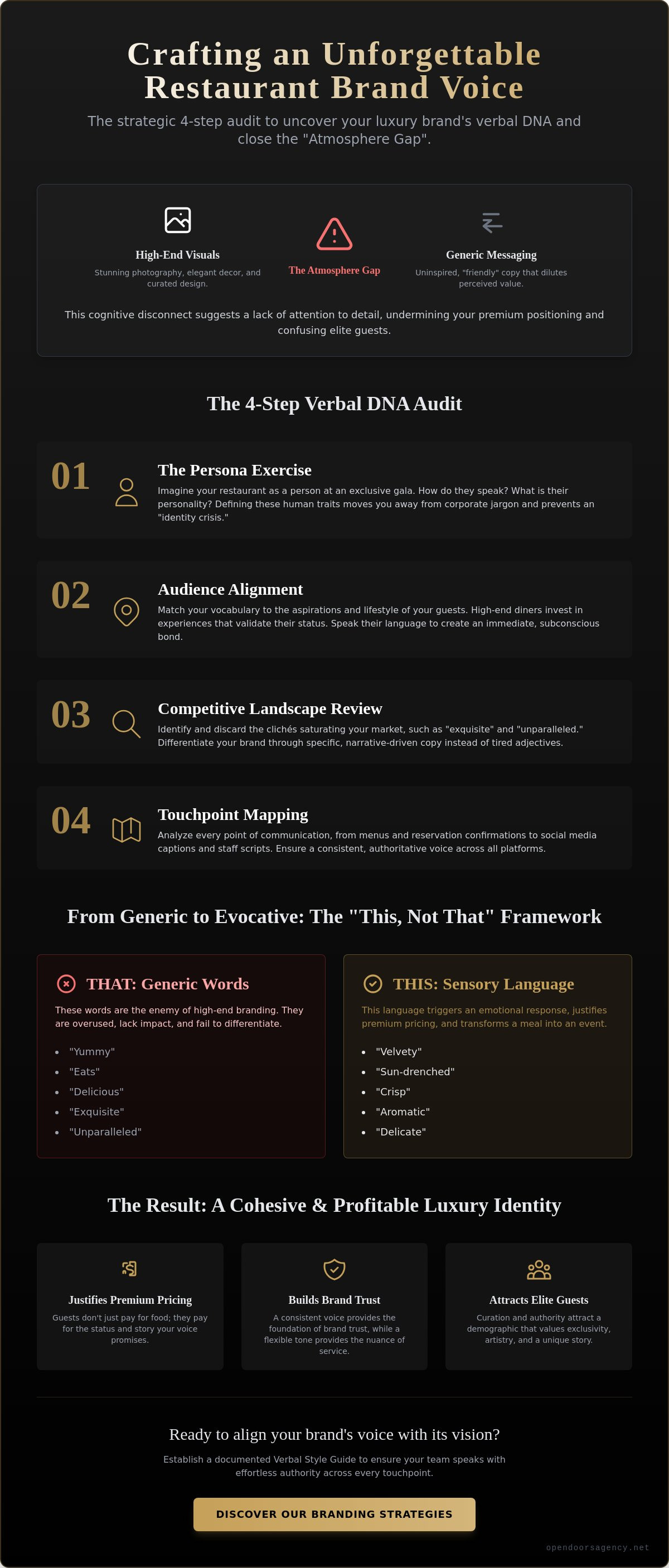
We often see a jarring disconnect between high-end aesthetics and generic communication. This is the Atmosphere Gap. When beautiful visuals meet uninspired, "friendly" copy, the brand's perceived value drops instantly. High-end guests notice this inconsistency. It suggests a lack of attention to detail that might extend to the kitchen or service. A curated voice bridges this gap, ensuring the verbal experience matches the visual excellence of your space.
A sophisticated verbal identity justifies premium pricing. It transforms a meal into an event. By using specific, sensory language, you trigger an emotional response that broad terms cannot reach. This level of curation attracts a demographic that values exclusivity and artistry. When your brand speaks with authority, guests don't just pay for food; they pay for the status and story your voice promises.
The Difference Between Tone and Voice
Voice is your restaurant's steady personality; think of it as the sophisticated host who never breaks character. Tone is the emotional inflection you apply based on the specific situation. You might use a formal tone for a reservation confirmation and a more evocative, poetic tone for an Instagram caption. In luxury hospitality, a consistent voice builds the foundation of brand trust while a flexible tone provides the necessary nuance of service.
Verbal Identity as a Competitive Advantage
In a saturated market like Miami, a distinct voice cuts through the noise. It builds "mental availability," ensuring your brand is the first choice when a guest considers a celebration. Generic "foodie" language is the enemy of high-end branding. Words like "yummy" or "eats" belong in a cafeteria, not a dining room with a view. A bold, authoritative voice signals that you are a tastemaker, not a follower. This differentiation is critical in a market where 88% of consumers are influenced by online reviews and digital presence before booking a table.
- Precision: High-end guests expect exactitude in every touchpoint.
- Exclusivity: Your vocabulary should reflect the rare nature of your offerings.
- Authority: Position your restaurant as the expert in its specific culinary niche.
The 4-Step Audit: Uncovering Your Restaurant's Verbal DNA
Building a legacy requires more than a signature dish; it demands a rigorous examination of how your brand communicates. You cannot begin developing a restaurant brand voice without first auditing your existing verbal assets. This process strips away generic marketing fluff to reveal the authentic core of your identity. It ensures that every word serves a strategic purpose, moving beyond simple information to create a distinct emotional resonance.
Step 1: The Persona Exercise. Imagine your restaurant as a guest at an exclusive gala. What are they wearing? How do they introduce themselves? Defining these human traits helps you move away from corporate jargon. If your brand is a person, their vocabulary becomes predictable and reliable. This exercise prevents the "identity crisis" often seen in new establishments trying to be everything to everyone.
Step 2: Audience Alignment. Your guests have specific aspirations. You must match your vocabulary to their lifestyle. High-end diners don't just buy a meal; they invest in an experience that validates their status. Use the language they use in their private circles. This creates an immediate, subconscious bond of "people like us eat here."
Step 3: Competitive Landscape Review. Identify the clichés saturating your niche. In the luxury sector, words like "exquisite" and "unparalleled" have lost their impact through overuse. Study restaurant branding best practices to see how global leaders differentiate themselves through specific, narrative-driven copy rather than tired adjectives. Our team often helps clients refine this through comprehensive branding strategies that prioritize unique positioning.
Step 4: Touchpoint Mapping. List every place your brand "speaks." This includes your digital menu, Instagram captions, physical signage, and even the automated reservation confirmation email. Each touchpoint is an opportunity to reinforce your voice. Inconsistency across these channels creates doubt in the guest's mind, whereas total alignment builds an air of professional mastery.
Defining Your Brand Archetype
Archetypes provide a psychological shortcut for your audience. The Creator focuses on culinary innovation and the "chef as artist" narrative. The Caregiver prioritizes heritage, warmth, and the feeling of being "seen" through impeccable service. The Explorer leans into exotic ingredients and the thrill of global discovery. Choose one primary archetype to anchor your messaging and prevent your voice from sounding muddled.
Audience Persona Deep-Dive
Effective communication targets psychographics over simple demographics. You aren't just speaking to "high-net-worth individuals." You are speaking to the Art Basel enthusiast who values rare aesthetic experiences. You are targeting the Michelin Guide devotee who prioritizes technical precision. Perhaps you are courting the Forbes Travel Guide loyalist who expects a specific standard of service. Understanding these affiliations allows you to tailor your tone to the "Miami luxury" traveler who seeks vibrancy, or the "local tastemaker" who demands exclusivity and discretion.
Developing Your Personality: From 'Friendly' to 'Unforgettable'
Generic adjectives are the death of luxury branding. While a neighborhood spot might settle for being "friendly" or "fresh," a high-end destination demands linguistic precision. Developing a restaurant brand voice involves curating a signature vocabulary that evokes the specific sensory details of your craft. You aren't just selling food; you're offering a narrative that justifies a premium price point. Precision in your language signals a commitment to excellence that high-net-worth guests expect.
Eliminate words like "delicious," "nice," or "tasty" from your brand's lexicon. These terms are subjective and lack authority. Replace them with sensory descriptors that describe texture, origin, and technique. Use words like "velvety," "charred," "botanical," or "aged." This shifts your brand from being a mere service provider to a "tastemaker." You are the expert guiding the guest through a curated experience. When you speak with authority, you build the trust required to command elite market status.
The 'This, Not That' Matrix
Creating clear boundaries for your content production team is essential for consistency. A "This, Not That" framework provides immediate clarity on what fits the brand and what dilutes it. Specificity is the hallmark of luxury hospitality branding; it removes ambiguity and reinforces your unique position in the market.
| Generic Phrase | Sophisticated Alternative |
|---|---|
| Great cocktails | Artisanal pours with a coastal narrative |
| Fresh ingredients | Sustainably sourced heirloom harvests |
| Friendly service | Intuitive hospitality and discrete care |
| A nice view | An immersive skyline panorama |
The Power of Storytelling and Narrative Arc
Your verbal identity shouldn't exist in a vacuum. It must align perfectly with your visual identity for restaurants to create a seamless guest experience. If your photography captures dark, moody textures and candlelight, your voice should be equally evocative and mysterious. Integrating the chef's personal journey or the historic significance of your building adds layers of value that guests can't find elsewhere.
Craft a brand manifesto that serves as the North Star for all future content. This is a short, punchy document that defines your "why" and your "how." It ensures that whether a guest is reading a social media caption or the back of a wine list, they encounter the same unmistakable personality. This narrative arc creates an emotional connection that fosters long-term loyalty, moving your restaurant from a one-time visit to a lifestyle choice.
Implementation: Training Your Team and Digital Platforms
Strategy remains theoretical until it reaches the guest. Execution is the final hurdle in developing a restaurant brand voice that actually converts. To maintain a consistent identity, you must move beyond vague concepts and into documented standards. A centralized Verbal Style Guide is your most valuable asset here. This document defines the technicalities of your brand's speech, including specific grammar preferences, punctuation rules, and even acceptable emoji usage. For a luxury brand, this might mean a total ban on exclamation points to maintain a composed, authoritative air.
Designate a Brand Guardian within your organization. This individual acts as the final filter for all outbound communication, ensuring that no social media post or menu update dilutes the brand's perceived value. When your voice is documented and policed, you empower your team to speak for the brand with confidence. This creates a sense of operational mastery that guests can feel at every touchpoint, from the initial reservation call to the final host greeting.
Social Media: The Front Line of Your Brand Voice
Digital platforms are where your brand voice lives and breathes daily. You must adapt your delivery to match the platform's energy without compromising your core personality. Instagram Reels require a more evocative, visual-led narrative, while TikTok often rewards a faster, more proactive rhythm. Consistency is especially critical when managing your reputation. Since online reviews influenced 88% of restaurant selections in 2023 according to Gitnux data, your responses must be impeccably "in character." A poised, professional response to a critique can do more for your brand than a dozen generic thank-yous. To ensure your digital narrative remains sophisticated, consider how a Miami food content creator can help translate your high-end voice into engaging short-form video.
The Menu as a Narrative Device
Your menu is a silent salesperson. It should do more than list ingredients; it should build anticipation. Use descriptive copy to increase the perceived value of your offerings by highlighting technique and provenance. Balance is essential. You need to provide enough clarity for the guest to make an informed choice while using personality to evoke an emotional response. Typography and layout also influence how your voice is "read." A minimalist design with significant white space communicates modern luxury, whereas traditional serif fonts suggest heritage and deep-rooted expertise. Every line of copy on that page is an opportunity to reinforce your status as a market leader.
We help brands bridge the gap between vision and reality through comprehensive content production that aligns your verbal and visual identity.
Visual and Verbal Synergy: The Opendoors Approach to Luxury
Aesthetics might secure the first impression, but your voice secures the relationship. High-end photography alone isn't enough to sustain a luxury brand in a market as competitive as South Florida. When you pair striking visuals with a generic message, you break the spell of exclusivity. Developing a restaurant brand voice ensures that your verbal narrative matches the caliber of your visual presentation. At Opendoors Agency, we bridge the gap between premium restaurant photography in Miami and a comprehensive brand strategy. Consistency is the ultimate luxury. It provides the seamless experience that elite guests demand.
Total brand immersion requires every element to pull in the same direction. If your imagery communicates mystery and depth while your captions are overly chatty, you create a disconnect. This friction erodes the guest's trust. We focus on creating a unified front where the texture of the photography informs the rhythm of the prose. This holistic approach removes the operational burden from your team, placing your brand's image in expert hands.
Content Production as a Strategic Asset
Stop simply "posting content." Start building a world. Luxury hospitality is about immersion. Every touchpoint should feel like part of a larger, cohesive story. Using a single partner for both visual and verbal storytelling eliminates the friction of misaligned messaging. We recently applied this strategy to a Miami hotel bar. By unifying their visual style with a sharp, evocative voice, the brand achieved a more defined and authoritative presence that resonated with its target demographic. This strategic approach turns content production into a tangible business asset rather than a recurring expense.
Elevating Your Brand Status
Maintaining a sophisticated voice requires discipline. It isn't a one-time project. It's a continuous commitment to excellence. Investing in professional branding and content retainers ensures your voice evolves alongside your guest's expectations. Developing a restaurant brand voice is a long-term play for loyalty and market share. Use this final checklist to audit your current status:
- Does your copy justify your price point at every touchpoint?
- Is your tone consistent across Instagram, your website, and your physical menu?
- Do you avoid generic industry clichés in favor of signature vocabulary?
- Does your verbal identity align perfectly with your visual aesthetic?
The transformative power of a unified brand cannot be overstated. It positions you as a tastemaker and a leader in the hospitality sector. When your visuals and voice work in harmony, you don't just attract guests; you build a legacy. Ready to refine your image? Elevate your hospitality brand with Opendoors Agency.
Master Your Brand's Narrative
Your restaurant's identity is more than a logo or a signature dish; it's the personality your guests encounter at every touchpoint. We've explored how auditing your verbal DNA and implementing a signature vocabulary turns a beautiful space into an unmistakable destination. Developing a restaurant brand voice is the strategic anchor that justifies premium pricing and builds lasting mental availability in a competitive market. When your words match the caliber of your cuisine, you create a seamless experience that resonates with elite guests.
Consistency is the ultimate hallmark of luxury. Opendoors Agency specializes in Miami's luxury hospitality sector, providing full-service branding and content production that bridges the gap between visual excellence and verbal authority. We possess a proven track record of elevating high-end restaurants and hotels through precise, strategic storytelling. Let us handle the complexities of your brand's image so you can focus on the art of hospitality. Book a Branding Consultation with Opendoors Agency to secure your position as a market tastemaker. Your brand's legacy begins with a single, sophisticated voice.
Frequently Asked Questions
What is the difference between brand voice and brand tone?
Brand voice is the steady, unchanging personality of your restaurant. It represents your core identity and values in every communication. Brand tone is the emotional inflection you apply to that voice based on the specific situation or platform. While your voice remains consistent, your tone might shift from formal in a legal disclaimer to evocative and poetic in a social media caption.
How do I choose the right voice for my restaurant?
Align your choice with your brand's primary archetype and the psychographics of your target guests. You must determine if your identity is rooted in culinary innovation, heritage, or global discovery. Developing a restaurant brand voice requires selecting a personality that feels authentic to your mission while speaking directly to the aspirations and lifestyles of high-net-worth individuals.
Can a restaurant have more than one brand voice?
No, a restaurant should never have more than one brand voice. Multiple voices create a muddled identity that confuses potential guests and erodes brand trust. Consistency is the foundation of luxury hospitality. You can vary your tone to suit different contexts, but your underlying personality must remain unmistakable to build the "mental availability" required for long term loyalty.
How often should I update my restaurant's brand voice?
Perform a verbal audit every twelve months to ensure your vocabulary remains sharp and relevant. Your core voice should stay steady for years to build a legacy, but your signature words may need refinement as market trends evolve. Significant updates are typically reserved for a complete rebranding or a major shift in your culinary concept to reflect a new direction.
Do I need a professional agency to develop my brand voice?
Professional agencies provide the strategic objectivity and creative expertise necessary to craft an elite verbal identity. An agency ensures your voice aligns perfectly with your photography and web design for a seamless guest experience. This comprehensive approach prevents the "Atmosphere Gap" and ensures your brand speaks with an authoritative confidence that justifies premium pricing.
How does brand voice affect my restaurant's SEO?
A distinct brand voice improves SEO by producing unique, high-quality content that increases user engagement and dwell time. Developing a restaurant brand voice involves using specific, semantic language that helps search engines understand your niche and authority. When your messaging is consistent across all platforms, it signals professional reliability and expertise to both guests and search algorithms.
What are common mistakes when developing a restaurant brand voice?
The most frequent error is settling for a generic, "friendly" persona that fails to differentiate your brand. Using overused marketing fluff like "fresh" or "exquisite" makes your restaurant sound like every other competitor. Another critical mistake is inconsistency across touchpoints, where your Instagram voice doesn't match the personality of your physical menu, creating a jarring disconnect for the guest.